
The long-awaited Netflix version of Richard Osman’s bestseller strips out the humor, miscasts Pierce Brosnan and turns cozy retirement sleuths into a Disneyfied Hogwarts.
It’s been five years since the movie adaptation of The Thursday Murder Club was announced. An agonizingly long wait for us superfans. Was it worth it?
Er, no.
They’ve taken the crown jewels of modern British mystery fiction and fumbled them straight down the drain.
Richard Osman’s books are warm, witty, and unmistakably British. This film — based on the huge bestselling first novel — feels like someone fed Downton Abbey, Harry Potter, and a tourist brochure into a blender and didn’t give two cents for the results.
The story should have been irresistible: four retirees in a luxury retirement village teaming up to solve a cold case tied to a decades-old East End killing. But here the movie opens with a flashback to the “1970s East End” that looks more 1873 than 1973, all gas lamps and Jack the Ripper fog.
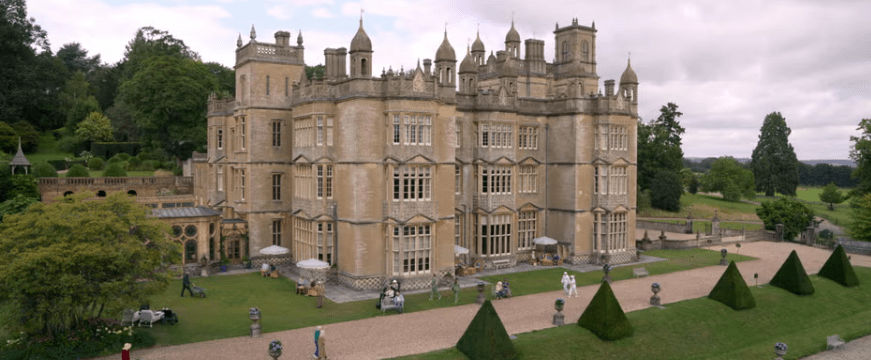
From there we lurch into Coopers Chase, complete with archery and endless watercolor classes. In the book, Coopers Chase was pleasant but recognizably ordinary — based on the retirement community where Osman’s own mother lives. Photos of the real place (see below) make it crystal clear how off-base this Hogwarts-style behemoth is.
The blame? Chris Columbus, the director who once steered Home Alone, Mrs. Doubtfire, and two Harry Potter films to box-office glory. He admitted he imagined Coopers Chase as a “Hogwarts version of a retirement home.”
Well, he shouldn’t have. The small-scale, domestic setting was part of the books’ charm. Blow it up, and you blow it.
The humor is gone too. Osman’s sly digs at everyday British life — Waitrose meal deals, quibbles over “flat” versus “apartment,” small comforts and petty complaints — grounded the mystery. Without them, the film is just pensioners wandering through a theme-park crime scene.
It’s tempting to lay the blame at the door of screenwriter Katy Brand (a fairly low-profile comedian in the UK) and Suzanne Heathcote but screenwriters are infamously on the bottom rung of the movie ladder. If Chris Columbus and the production companies involved (none of them British) wanted the screenplay this way, who was to argue?
Casting makes things worse. Pierce Brosnan, charming though he always is, is miscast as Ron, the former trade union bruiser. In the book he’s a hard-edged ex-communist who clashed with Thatcher’s Britain — the sort of role Bob Hoskins or Michael Caine would have nailed twenty years ago. Instead we get Brosnan, suave, tan, and living in implausible luxury.
How would a lifelong class warrior end up in a gilded retirement complex? The movie doesn’t bother to explain.
Elsewhere, Sir Ben Kingsley is acting on half a cylinder. He’s so overqualified it’s insulting: like asking Lewis Hamilton to drive a ride-on mower, or Gordon Ramsay to butter a piece of toast.
Daniel Mays’s detective behaves like it’s 1940, not knowing his colleagues’ first names, while the only black officer is reduced to pouring tea — a scenario that in real life would trigger instant lawsuits.
And the supposedly feared criminal mastermind? Richard E. Grant, about as terrifying as Liberace in a Halloween cape.
The plot doesn’t help: tattoos revealed at convenient moments, a metal knee spotted twice in one week, almost no actual detection. Meanwhile, the assisted-dying subplot is handled far more bluntly than in the novel, and not everyone will approve.
To be fair, Joanna Johnston’s costumes flatter, and the retirees look sharp. But Thomas Newman’s score is generic, forgettable. Not good enough from the man who gave us the Shawshank theme.
The books worked because they were small, cozy, and rooted in British eccentricity. Strip that away, inflate Coopers Chase into Hogwarts, and you lose everything that made them sparkle. What’s left is a glossy, bloated misfire: a Disneyland England where even TV detective shows look gritty by comparison.
The real Coopers Chase




 Jessica Harper Uncanceled
Leave a reply to Jessica Harper Cancel reply